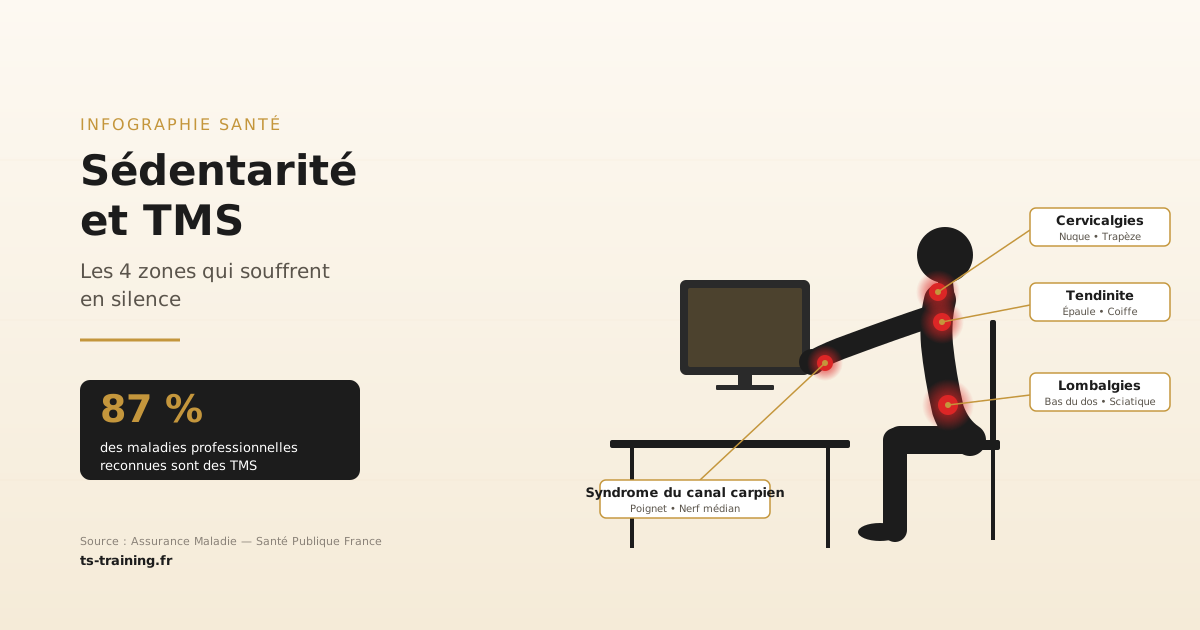
Sitting for more than 8 hours a day doubles the risk of cardiovascular disease. Sedentary behaviour is now classified by the World Health Organisation as the 4th leading cause of mortality worldwide, just behind tobacco, hypertension and diabetes. And it's the breeding ground for musculoskeletal disorders — those well-known MSDs — which affect office workers and retirees in front of their TV alike.
In this article, we break down what sedentary behaviour really does to your body, why MSDs appear, and above all how to prevent them with simple actions and adapted support.
What is sedentary behaviour (and why is it more serious than you think)?
Sedentary behaviour isn't just "not doing sport". It's the time spent sitting or lying down outside of sleep, with minimal energy expenditure. Watching TV, working at a computer, driving, reading on the sofa: all these activities count.
The figures are staggering:
- The average French adult spends 7h24 sitting every day (Esteban study, Santé Publique France).
- For 18-34 year-olds, the average rises to 10 hours per day.
- Among seniors, 1 in 2 is considered sedentary by WHO criteria.
Yet the human body is designed to move. When you stay seated for hours on end, metabolism slows, blood circulation stagnates, postural muscles weaken and bone density drops. The consequences set in silently, year after year.
MSDs: definition and affected areas
Musculoskeletal disorders (MSDs) are a group of conditions affecting muscles, tendons, nerves and joints, most commonly at:
- Neck and shoulders: neck pain, trapezius syndrome, frozen shoulder
- Back: chronic lower back pain, herniated discs, sciatica
- Wrists and elbows: carpal tunnel syndrome, lateral epicondylitis (tennis elbow)
- Hips and knees: early osteoarthritis, tendinopathies, patellar pain
MSDs account for 87% of recognised occupational diseases in France (Assurance Maladie). But they also massively affect people not in employment: retirees, family carers, remote workers without proper ergonomics.
Why sedentary behaviour triggers MSDs
Several mechanisms add up:
1. Postural muscles fall asleep
Deep muscles (transverse abdominal, multifidus, deep glutes) lose their tone. As a result, the spine is no longer properly supported, and the entire load shifts onto the intervertebral discs and ligaments. That's the starting point for most chronic lower back pain.
2. Some muscles shorten, others lengthen
Prolonged sitting = shortened psoas, retracted hamstrings, inhibited glutes, shoulders rolled forward. This muscular imbalance creates permanent tension that eventually causes pain and inflammation.
3. Circulation stagnates
Less oxygenated blood in the tissues = slower cellular repair, low-grade chronic inflammation, accumulation of toxins in the fascia. The perfect ground for tendinopathies and diffuse pain.
4. Ergonomics aren't enough
Even the best ergonomic chair doesn't replace movement. The ideal isn't to "sit well" for 8 hours, but to not sit for 8 hours.
"The human body is like a bicycle: if it doesn't move, it rusts. Sedentary behaviour rusts not just muscles but also weakens bones, joints and even the brain."
The 6 warning signs not to ignore
Your body talks to you well before MSDs set in. Here are the signs that should push you to act:
- Morning stiffness that takes more than 20 minutes to disappear
- Recurring pain in the same place (shoulder, lower back, neck)
- Tingling in hands or feet at the end of the day
- Breathlessness during everyday efforts (climbing 2 flights, carrying shopping)
- Heavy legs in the evening
- Persistent fatigue despite adequate sleep
These signals in isolation are common. Stacked together, they herald a tip into chronic pain. Better to act early, with adapted physical activity, than to treat an established MSD.
How to prevent — or reverse — the effects of sedentary behaviour
1. Break sitting periods every 45 minutes
The most effective rule: get up for 2 to 3 minutes every 45 minutes. Walk, stretch, drink a glass of water. This "micro-break" restarts circulation and wakes postural muscles. It's the foundation.
2. Hit 150 minutes of moderate activity per week
WHO recommendation: 30 minutes of moderate activity (brisk walking, cycling, swimming) 5 days a week. It doesn't replace breaking sitting, but it's the minimum baseline to protect the cardiovascular system.
3. Strengthen the deep muscles (core and mobility)
2 sessions a week of targeted work on the postural chain change things in 6 to 8 weeks. Gentle core work, balance exercises, joint mobility, glute strengthening: that's exactly what we work on in our in-home sessions to rebuild a strong body.
4. Get a postural assessment
A personal trainer trained in sport & health identifies your asymmetries, weak muscles and tension zones. They then adapt a bespoke programme that targets exactly your needs. Copying a generic YouTube routine never gives the same results.
Sedentary behaviour affects retirees too, not just employees
MSDs are often discussed in the workplace, but the transition to retirement is a moment of heightened vulnerability: daily commutes disappear, social stimulation drops, screen time explodes, the comfortable chair becomes the centre of the day.
As a result, in those aged 65 and over, sedentary behaviour is now a major risk factor for:
- Sarcopenia (muscle loss) — up to 3% of muscle mass lost per year after 60 without activity
- Osteoporosis (loss of bone density) — bone needs mechanical loading to stay strong
- Falls — 1 senior in 3 falls each year, often due to deteriorated balance
- Progressive loss of autonomy over 5 to 10 years
The good news: it's never too late. Studies on people over 80 show muscle strength gains of 20 to 30% after 12 weeks of adapted training.
In-home coaching: the anti-sedentary solution that works
Why a coach who comes to you changes everything:
- No excuses: no need to travel to a gym, drive, or find parking. The coach is at your door at the agreed time.
- Exact adaptation: the coach observes your environment, your habits, your furniture. They build the programme inside your reality, not a theoretical gym.
- Real-time correction: every movement is checked, corrected, refined. You never reinforce bad postures.
- Constant motivation: a fixed appointment with a coach who comes to you is the best way to stick with it long-term.
At TS Training, every week we work in Nice, Antibes, Cannes and Monaco with people of all ages who want to break out of sedentary behaviour, prevent or treat MSDs, and find a body that obeys them again.
Tackling sedentary behaviour starts with one first session
Your first assessment session is free. A coach comes to your home to evaluate your posture, identify your risk areas and propose a bespoke plan.
Book my free assessment session