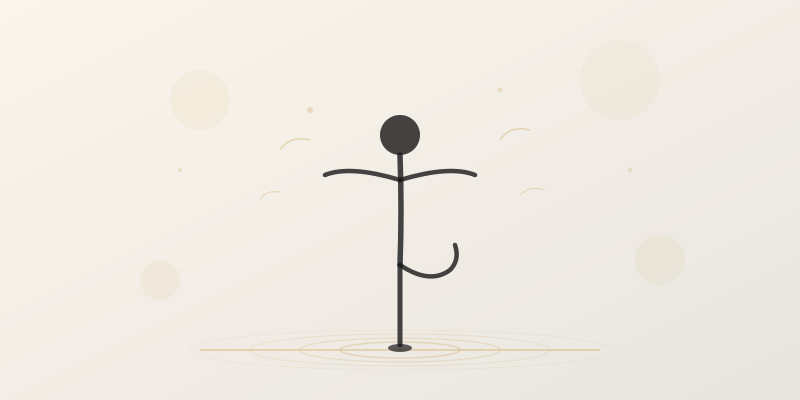
Why balance declines with age
From age 50, three systems essential to balance gradually decline: vision (depth perception), the inner ear (vestibular receptors) and proprioception (the receptors in your muscles and joints that tell your brain where your body is in space).
Add the loss of muscle mass (sarcopenia) and joint stiffness, and you can see why a simple uneven surface can become a hazard.
In France, falls cause more than 9,300 deaths each year in people over 65, and 76,000 hospital admissions. They are the leading cause of accidental death in seniors.
The good news: balance can be trained and improved at any age. A few simple exercises, practised regularly, are enough to significantly reduce the risk of falling.
For all the exercises below, always position yourself next to a stable support: a sturdy chair, a worktop or a wall. Never do these exercises without an accessible point of support.
Exercise 1: Single-leg stance
Goal: strengthen stability and postural muscles.
Standing next to a chair, rest one hand lightly on the back. Lift one foot off the ground a few centimetres and hold the position.
- Beginner: 10 seconds per leg, hand on the chair
- Intermediate: 20 seconds, fingertips on the chair
- Advanced: 30 seconds, no support (chair within reach)
Do 3 sets on each side. If you wobble a lot, that's normal at first — it's the very sign your body is working.
Exercise 2: Heel-to-toe walking
Goal: improve coordination and proprioception.
Walk in a straight line, placing your heel just in front of the toes of your other foot, as if walking along a beam. Keep your gaze fixed straight ahead, not at the ground.
- Take 10 steps in one direction, then 10 steps back
- Walk along a wall so you can catch yourself if needed
- Repeat 3 times
Exercise 3: Sit-to-stand transfers
Goal: strengthen the quadriceps and glutes, essential muscles for getting up.
Sit on a stable chair (not a soft armchair). Stand up without using your hands, then sit back down slowly, controlling the descent. The movement should be smooth, not abrupt.
- Beginner: 5 reps, hands on thighs to help
- Intermediate: 8 reps, arms crossed on chest
- Advanced: 10 reps, arms outstretched in front
This is one of the most functional exercises out there. Standing up from a chair without using your hands is a health marker recognised by geriatricians. If you can't manage it today, it's an excellent goal to work towards.
Exercise 4: Lateral step
Goal: work on stability in sideways movement (which often causes falls).
Standing, feet together, take a big step to the side with your right foot, then bring your left foot to meet it. Move 10 steps to the right, then 10 to the left.
- Keep knees slightly bent
- Keep your torso upright, don't lean
- For more challenge, add a resistance band around the ankles
Exercise 5: The imaginary clock
Goal: work on dynamic balance in every direction.
Imagine you are at the centre of a clock. Standing on your left leg, touch the floor with your right foot at 12 o'clock (front), 3 o'clock (side), 6 o'clock (behind). Return to centre between each position.
- 3 sets on each side
- Stand near a chair to start
- Reach as far as you can without losing balance
When and how often
For measurable results, practise these exercises 3 times a week, for 10 to 15 minutes. You can fit them into your morning routine, before breakfast for example. The first improvements appear in 3 to 4 weeks: you'll feel more stable, more confident on stairs and on pavements.
When to consult
See your doctor if:
- You've had a fall in the past 6 months
- You experience frequent dizziness or light-headedness
- You take medication that affects balance (sleeping pills, antihypertensives)
- You have joint pain that prevents certain movements
Want some support?
Your first assessment session is free. A coach comes to your home to evaluate your balance and build a tailored programme.
Book my free assessment session